
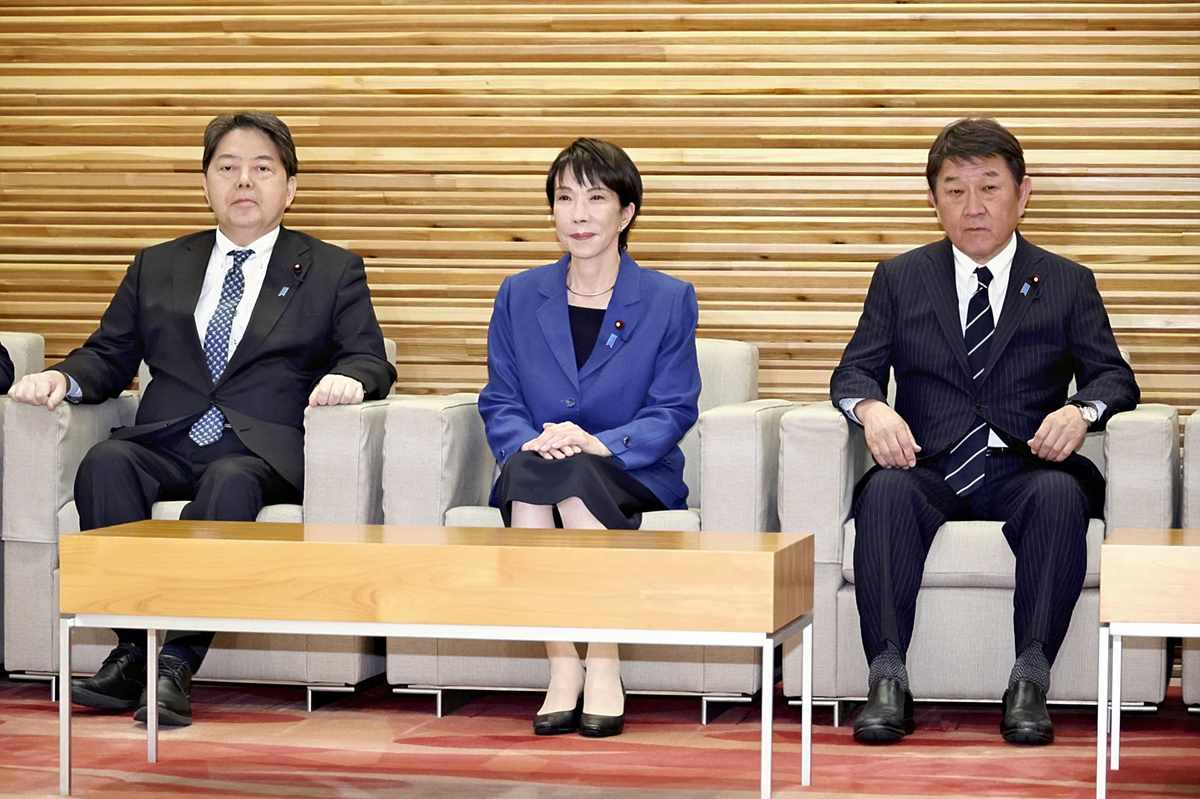
Prime Minister Sanae Takaichi and other ministers attend the Cabinet meeting on Friday.
15:52 JST, November 21, 2025
TOKYO (Jiji Press) — The Japanese government on Friday adopted a comprehensive economic package worth some ¥21.3 trillion in state funds, aiming to achieve a strong economy through strategic fiscal spending.
The first economic package compiled under Prime Minister Sanae Takaichi, who advocates responsible, proactive fiscal policy, features measures against high prices, as well as investment in growth sectors.
General-account expenditures under the government’s planned fiscal 2025 supplementary budget, which will finance measures in the package, will be around ¥17.7 trillion , a new post-pandemic high.
Including related spending by the private sector, the package is worth around ¥42.8 trillion .
“What Japan should do is to strengthen its national power through proactive fiscal policy,” Takaichi told reporters after the economic package was adopted at an extraordinary cabinet meeting.
At the same time, the prime minister said that the revised government bond issuance amount for fiscal 2025, combining the initial and supplementary budgets, is expected to fall below the previous fiscal year’s total of ¥42.1 trillion .
Of the government funds to be allocated for the economic package, around ¥11.7 trillion will be spent for ensuring livelihood security and addressing high prices, some ¥7.2 trillion for realizing a strong economy through crisis management investment and growth investment and about ¥1.7 trillion for strengthening defense and diplomatic capabilities.
The Cabinet Office projects that over the next three years, the economic measures will boost the growth rate of Japan’s real gross domestic product by an average of around 1.4 percentage points annually, or by some ¥24 trillion .
As part of efforts to tackle rising prices, which the government has positioned as its top priority, ¥7,000 in total will be provided for an average household as subsidies for electricity and gas bills between January and March. Government funds allocated for this initiative will be ¥500 billion .
Also, the government will set aside ¥2 trillion for its existing grant program that allows regional governments to flexibly decide how to use the funds to counter rising prices, hoping to encourage the introduction of measures such as the utilization of rice vouchers and electronic coupons.
To all households with children aged zero to 18, the government will provide a one-time allowance of ¥20,000 per child.
The package also includes large-scale tax reductions.
As for strategic investment through public-private partnerships, the government will explore a new framework to secure funding sources for strengthening fields essential to economic security, such as quantum technology and critical minerals. To revitalize the shipbuilding industry, whose international competitiveness has declined, the government will establish a 10-year fund with the aim of realizing around ¥1 trillion in public-private investment.
To enhance Japan’s defense capability, the government plans a budget allocation to raise its defense spending to 2% of the country’s GDP by the end of fiscal 2025, two years earlier than initially planned.



Popular Articles
Popular articles in the past 24 hours
-

Japan Finance Chief Effectively Accepts BOJ Rate Hike
-

Moscow Court Rules ICC President Akane, Others Guilty
-
Liberal Democratic Party Body Proposes Active Use of JBIC for Cor...
-
◎あいさつする木原官房長官_20251214YGTGS000395_C-2-e1765689477785-250x170.jpg)
Japan Govt Vows All-Out Push to Resolve North Korea's Abduction I...
-
Tokyo Economic Security Forum to Hold Inaugural Meeting Amid Tens...
-

Doan Solo Fires Frankfurt past Augsburg
-

I’m Tired of My Mother’s Self-Centered, Abusive Behavior
-

Sambusa Delight with Crispy Outside, Juicy Inside; Party Snack Pa...
Popular articles in the past week
-
M4.9 Earthquake Hits Tokyo, Neighboring Prefectures
-
M7.5 Earthquake Hits Northern Japan; Tsunami Waves Observed in Ho...
-
High School in Kyoto Says Students Shoplifted during Recent Schoo...
-
Japan Pulls out of Vietnam Nuclear Project, Complicating Hanoi's ...
-
South Korea's Top Court Dismisses Nippon Steel Appeal in Lawsuit ...
-
75% of Myanmar People Reject Army's Political Involvement, Accord...
-
Tsunami Advisory Lifted; Earthquake with Estimated Magnitude of 6...
-
‘Bear' Takes Top Spot as Japan's Kanji of the Year, Reflecting Ye...
Popular articles in the past month
-
Japan’s Hopes for Seafood Exports Shot Down in China Spat
-
Essential Services Shortage to Hit Japan's GDP By Up to ¥76 Tril....
-

Japan to Charge Foreigners More for Residence Permits, Looking to...
-
Japan Exports Rise in October as Slump in U.S. Sales Eases
-

Japan GDP Down Annualized 1.8% in July-Sept.
-
Niigata Gov. to OK Restart of N-Plant; Kashiwazaki-Kariwa May Be ...
-
8 Japanese Nationals Stranded on Indonesia's Sumatra Island
-
M4.9 Earthquake Hits Tokyo, Neighboring Prefectures
"Business" POPULAR ARTICLE
-
Japan’s Hopes for Seafood Exports Shot Down in China Spat
-
Essential Services Shortage to Hit Japan’s GDP By Up to ¥76 Tril. By 2040
-
Japan Exports Rise in October as Slump in U.S. Sales Eases
-
Japan GDP Down Annualized 1.8% in July-Sept.
-
Niigata Gov. to OK Restart of N-Plant; Kashiwazaki-Kariwa May Be Tepco’s 1st Restarted Plant Since 2011
JN ACCESS RANKING
-
Japan’s Hopes for Seafood Exports Shot Down in China Spat
-
Essential Services Shortage to Hit Japan’s GDP By Up to ¥76 Tril. By 2040
-
Japan to Charge Foreigners More for Residence Permits, Looking to Align with Western Countries
-
Japan Exports Rise in October as Slump in U.S. Sales Eases
-
Japan GDP Down Annualized 1.8% in July-Sept.